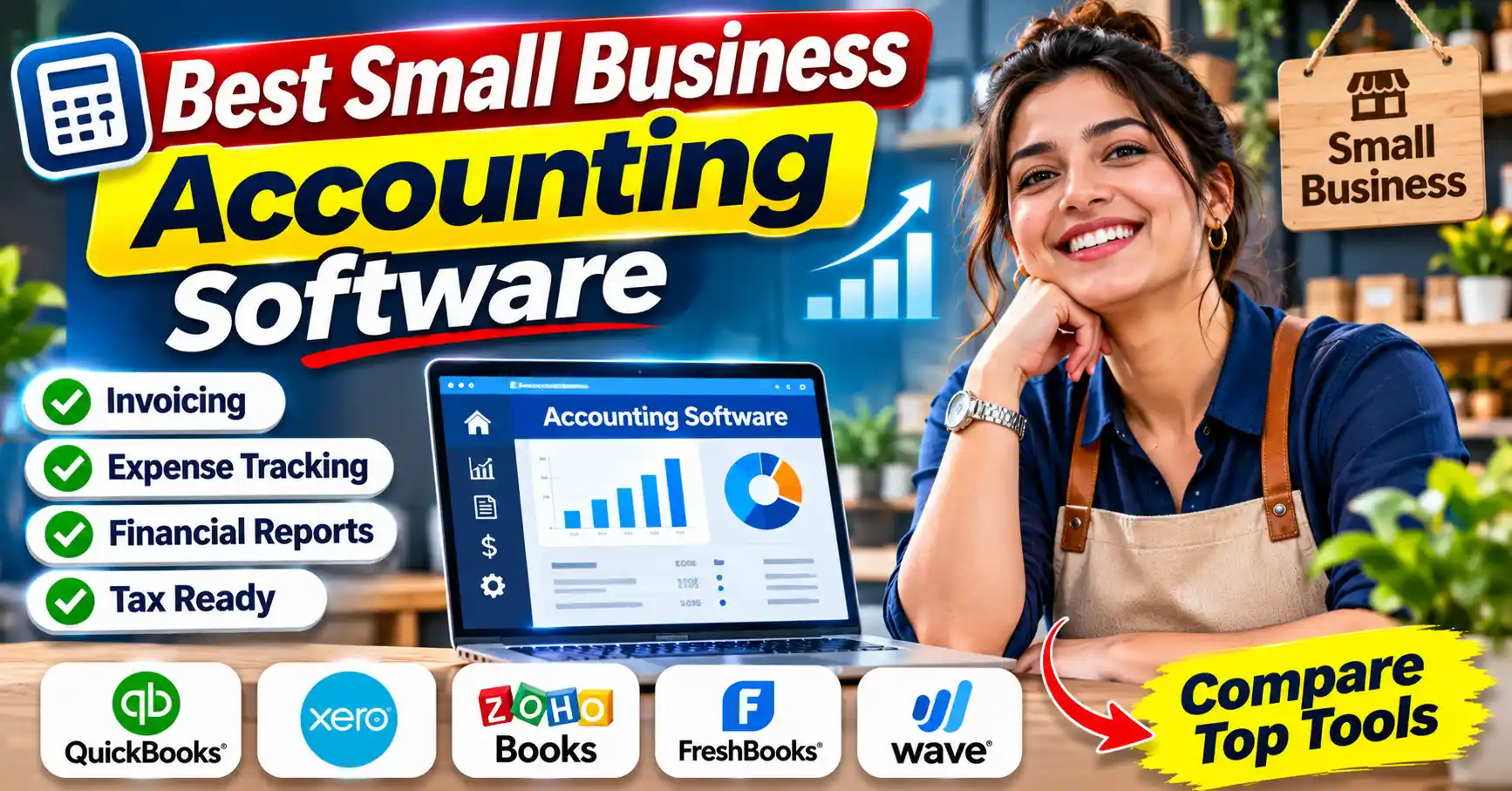
Finding the right accounting software can mean the difference between surviving an IRS audit and facing steep penalties. In 2026, US small businesses need systems that handle GAAP compliance, 1099-NEC filings, and automated bank reconciliation without hidden fee traps. As a financial professional, I’ve tested the market’s top tools to show you exactly what works, what doesn’t, and what it truly costs to keep your books bulletproof.
Key Takeaways
- The Industry Standard: QuickBooks Online holds the US market share, starting at ~$30/month, but watch out for steep tier upgrades when adding payroll or multiple users.
- The Scalability Winner: Xero offers unlimited users on all plans (starting at just $15/month), making it the most cost-effective choice for expanding teams.
- The Legitimate Free Tier: Wave remains the only safe, truly free core accounting platform, making it ideal for micro-businesses (though credit card processing and payroll carry standard fees).
- 2026 Compliance Standard: Do not buy software without automated SOC 2-compliant bank feeds and built-in IRS Schedule C mapping.
Quick Summary: Top Platforms at a Glance
| Platform | Best For | 2026 Starting Price | Standout Feature |
| QuickBooks Online | Comprehensive US Tax Compliance | ~$30 / month | Direct CPA access & deep tax mapping |
| Xero | Expanding Teams & E-commerce | ~$15 / month | Unlimited users on all tiers |
| Wave | Freelancers & Solopreneurs | $0 / month | 100% free core accounting & invoicing |
| FreshBooks | Service-Based Businesses | ~$19 / month | Built-in time tracking & proposals |
Read This Also: Best Dental Insurance for Seniors in 2026: Expert Guide
What is the Top Small Business Accounting Software?
For the majority of US businesses, QuickBooks Online holds the crown as the best overall small business accounting software. Its dominance comes down to one simple fact: every CPA in the United States knows how to use it. However, the “top” software is entirely subjective to your business model. While QuickBooks is the industry standard for traditional businesses, Xero has aggressively captured the e-commerce and international market, and FreshBooks remains the undisputed champion for solo service providers.
Why Cloud Accounting Software is Now Mandatory for US Compliance
In 2026, desktop-based ledgers are a liability. Cloud accounting software is essentially mandatory because the IRS increasingly scrutinizes digital audit trails and the exact timestamps of your transaction categorization. Cloud platforms utilize SOC 2 Type II compliance to encrypt your financial data and automatically sync your bank feeds via Open Banking APIs. If you ever face an audit, the IRS requires unalterable digital records. Cloud systems lock closed periods so you (or a rogue employee) cannot retroactively doctor financial statements.
The True Price of Top Platforms
Buying software based solely on the advertised entry price is the fastest way to blow your operational budget. Here is what you actually pay once the promotional discounts expire:
- QuickBooks Online: Starts at ~$35/month (Simple Start). However, the moment you need to track inventory or add up to 5 users, you are forced into the “Plus” tier at $99/month, and the “Advanced” tier now reaches upwards of $235 to $340/month.
- Xero: Starts at $15/month. Their “Standard” plan sits around $42/month and includes unlimited users—a massive cost advantage.
- FreshBooks: Starts at $19/month (Lite), capping you at 5 billable clients.
Affordable Accounting Software for Tight Budgets
If QuickBooks feels too expensive, Xero is the most affordable accounting software that doesn’t compromise on GAAP compliance. Because Xero doesn’t charge per-seat licenses, a growing team of five can operate on Xero Standard ($42/month) compared to QuickBooks Plus ($99/month). Alternatively, Zoho Books offers an incredibly robust ecosystem for budget-conscious teams already utilizing the Zoho suite.
Is Free Accounting Software for Small Business Safe to Use?
Yes, but only if you use a legitimate provider. Wave is the only free accounting software for small business that we recommend because it provides true double-entry accounting at zero monthly cost. However, “free” means they monetize elsewhere: you will pay standard processing fees (e.g., 2.9% + $0.60) when clients pay your invoices via credit card, and you must pay extra if you want access to live customer support or payroll.
Best Accounting Software for Startups & Scaling LLCs
High-growth startups require platforms that can handle multi-entity management, complex revenue recognition, and eventual transition to an ERP system. Xero is widely considered the best accounting software for startups due to its open API, which integrates seamlessly with modern fintech stacks (like Stripe, Mercury, and Gusto). If your startup is scaling quickly, ensure your software is correctly mapped to your corporate structure right after you form your entity.
Pros & Cons of the Leading Providers
QuickBooks Online
- Pros: Universal CPA familiarity; deep US tax compliance; robust inventory and reporting tools.
- Cons: Expensive tier upgrades; poor customer support for basic plans; strict user limits.
Xero
- Pros: Unlimited users on all plans; exceptional bank reconciliation tools; highly customizable API.
- Cons: Smaller US accountant network compared to QBO; steep learning curve for non-accountants.
Wave
- Pros: 100% free core accounting; simple and clean interface; great for micro-businesses.
- Cons: No built-in time tracking; difficult to scale; no dedicated audit trails for complex enterprises.
Read this Also : Travel Insurance Guide 2026: Costs, Claims & Protection
Accounting vs. Small Business Bookkeeping Software: What’s the Difference?
Many founders use the terms interchangeably, but there is a strict legal difference. Small business bookkeeping software is designed merely to track cash in and cash out (categorizing receipts and sending invoices). Accounting software takes that bookkeeping data and applies GAAP rules to generate complex tax-ready financial statements, handle asset depreciation, and produce audit-proof balance sheets. If you plan to file business taxes or apply for a commercial loan, you need full-suite accounting, not just a digital ledger.
Frequently Asked Questions
What is the best accounting software for a small business?
QuickBooks Online is the most recommended platform for US businesses due to its comprehensive tax mapping and universal CPA adoption. However, Xero is a highly capable and cost-effective alternative if you have a growing team and need unlimited user seats.
Can I use Excel instead of accounting software?
No, Excel does not comply with GAAP standards and lacks a secure, timestamped digital audit trail. The IRS highly scrutinizes manual spreadsheets, making dedicated cloud software a necessity for true audit protection.
Is QuickBooks really better than Xero?
QuickBooks is generally better for traditional US businesses with complex inventory needs and local accountants. Xero is often better for tech startups, service agencies, and e-commerce businesses that require scalable, multi-user access without tier-upgrade penalties.
What is the best free bookkeeping software?
Wave is currently the safest and most robust free platform available to US business owners. It provides true double-entry bookkeeping at zero monthly cost, charging you only for payment processing and optional payroll add-ons.
Do I need a CPA if I use accounting software?
Yes, software only automates the organization and categorization of your daily transactions. You still need a licensed CPA or EA to interpret that financial data, file your corporate tax returns, and provide strategic tax-saving advice.
Expert Verdict: Which Platform Should You Choose?
As a practicing financial professional, my final recommendation comes down to your business structure and growth trajectory. If you want the safest, most CPA-friendly route and don’t mind paying a premium as you grow, QuickBooks Online remains the undisputed gold standard. If you are a rapidly scaling startup looking for unlimited user access without the hidden penalty fees, Xero is your best bet. And if you are a solo freelancer just starting out, Wave will keep your ledger compliant for free until you are ready to upgrade.
Ultimately, trying to cut corners on your bookkeeping is a massive legal liability. Investing in the right accounting software today is the cheapest insurance policy you can buy against a devastating IRS audit tomorrow.
2 thoughts on “Best Accounting Software for Small Business 2026”